What Is Political Socialization? A Guide for Students

Political socialization is the lifelong process through which people develop…
Political socialization is the lifelong process through which people develop their political beliefs, values, and attitudes. It explains why you might share your parents’ views on certain issues, or why a college class can completely shift how you see government. For students studying political science, understanding this process is the first step toward understanding how entire societies form public opinion.
This guide breaks down the concept in plain language. You’ll learn the main agents of political socialization, the stages in which it occurs, and why it matters for democracy.
What Does Political Socialization Mean?
Political socialization is the process by which individuals acquire their political identity. It shapes how people view authority, government, rights, and civic duty. This process starts in early childhood and continues throughout adulthood.
Unlike a single lesson or event, political socialization builds up gradually. Small experiences, conversations, and observations accumulate over years. By adulthood, most people hold a fairly stable set of political attitudes, even if those attitudes still shift with new information.
Political scientists often describe this as the foundation of political culture. A society’s shared political culture depends on how its members are socialized. Countries with strong civic traditions tend to produce citizens who vote more, trust institutions more, and engage more in public debate.
Why Political Socialization Matters for Students
Students encounter political socialization directly in two ways:
- As a subject of study. It appears in political science, sociology, and civics courses because it explains voter behavior, party identification, and public opinion trends.
- As a personal experience. Every student has already been shaped by this process, often without realizing it.
Understanding the theory helps students recognize their own influences. It also helps them analyze why different groups vote differently or hold different views on the same issue.
The Main Agents of Political Socialization
Sociologists identify several agents of political socialization — the people, institutions, and experiences that transmit political values. These are the building blocks of the entire process.
1. Family
Family is usually the strongest and earliest influence. Children absorb political opinions from parents through everyday conversation, not formal lessons. Studies consistently show that party identification often mirrors parental preference well into adulthood, though the strength of this link has weakened somewhat in recent decades due to increased media exposure.
2. Education
Schools teach more than history and civics facts. Classroom rules, group projects, and student government all model how authority and participation work. Formal civic education, when done well, increases political knowledge and voter turnout later in life.
3. Peer Groups
Friends and classmates matter more as people move into adolescence and young adulthood. Peer influence often reinforces existing views, but it can also introduce entirely new perspectives, especially in diverse social settings like college campuses.
4. Media
Traditional news, social media, and entertainment all shape political attitudes today. Media exposure has grown so significant that some researchers now rank it alongside family as a primary agent. Algorithms on social platforms can also narrow the range of political views a person sees, which affects how balanced their understanding becomes.
5. Religion
Religious institutions often connect moral teachings to political positions on issues like social justice, family policy, or economic fairness. This influence varies widely depending on denomination and level of religious involvement.
6. Major Life Events
Wars, economic recessions, pandemics, and social movements can reshape political attitudes at a national scale. These events act as socialization moments for entire generations, not just individuals.
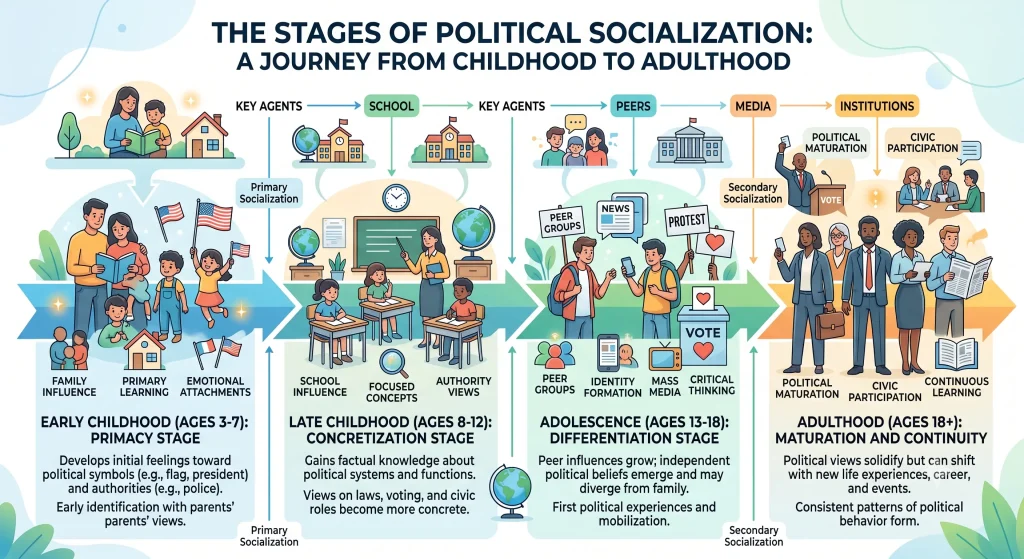
Stages of Political Socialization
Political socialization isn’t a single event. It unfolds across life stages:
- Childhood (ages 3–12): Basic attachment to national symbols and authority figures develops. Children learn concepts like fairness and rules through family and school.
- Adolescence (ages 13–19): Peer influence grows. Teenagers begin forming opinions on specific issues, often testing ideas against family beliefs.
- Young adulthood (ages 18–29): First voting experiences, higher education, and entering the workforce solidify political identity.
- Adulthood: Attitudes become more stable but can still shift due to major life events, career changes, or new social circles.
This staged model helps explain why voter turnout and political engagement patterns differ so much by age group.
Political Socialization vs. Political Culture
These two terms are related but not identical. Political socialization is the process of learning political values. Political culture is the outcome — the shared set of attitudes, beliefs, and practices within a society.
Think of it this way: socialization is the mechanism, and political culture is the result across an entire population. A society with weak civic education systems will likely develop a different political culture than one with strong civic traditions.
How Political Socialization Shapes Democracy
Healthy democracies rely on citizens who understand their rights and responsibilities. This is where civic education becomes essential. Countries that invest in structured civics programs tend to see:
- Higher voter turnout among young people
- Greater trust in democratic institutions
- More informed public debate on policy issues
Weak or inconsistent political socialization, by contrast, is linked to voter apathy and lower civic participation. This is one reason many governments and schools treat civics curricula as a policy priority, not just an academic subject.
Common Misconceptions About Political Socialization
Myth: It only happens in childhood. In reality, political attitudes can change throughout life, especially after major events like elections, wars, or economic shifts.
Myth: Family always determines political views. Family influence is strong but not absolute. Education, peer groups, and media exposure can override early family influence, especially in adulthood.
Myth: It’s the same as political indoctrination. Political socialization is a natural, ongoing process of learning. Indoctrination is a deliberate, often coercive effort to install specific beliefs. The two are related concepts but not interchangeable.
Key Takeaways
- Political socialization is the process of forming political beliefs and identity over a lifetime.
- The main agents are family, education, peers, media, religion, and major life events.
- It happens in stages, from early childhood through adulthood.
- It differs from political culture, which is the collective result of socialization across a society.
- Strong civic education strengthens democratic participation.
FAQ Section
Q: What is political socialization in simple terms? A: Political socialization is the process by which people learn their political beliefs and values, usually through family, school, media, and personal experiences over time.
Q: What are the main agents of political socialization? A: The primary agents are family, education, peer groups, media, religion, and significant life events such as wars or economic crises.
Q: Does political socialization stop after childhood? A: No. While childhood and adolescence are formative periods, political attitudes can continue to change throughout adulthood due to new experiences and major events.
Q: How is political socialization different from political culture? A: Political socialization is the ongoing process of learning political values. Political culture is the resulting shared set of beliefs and practices across a society.
Q: Why is political socialization important for students? A: It helps students understand how public opinion forms, why voting patterns differ by age group, and how their own beliefs developed.