Why a Political Party Is Important in Politics

A political party is important in politics because it organizes…
A political party is important in politics because it organizes public opinion, recruits leaders, and turns individual votes into workable government. Without parties, voters would face hundreds of unconnected candidates with no shared platform. Political parties give structure to elections, policymaking, and accountability, which is why nearly every modern democracy relies on them.
This article breaks down exactly why political parties matter, how they function, and what happens when party systems weaken. It’s written for students, first-time voters, and anyone trying to understand the basics of political science.
What Is a Political Party?
A political party is a group of people who share similar political goals and values. They organize to win elections, gain public office, and influence government policy. Parties are not just labels on a ballot. They are institutions that connect citizens to their government.
Political scientists generally agree that a party performs three core tasks:
- It nominates candidates for public office.
- It develops a policy platform voters can evaluate.
- It organizes elected officials once they take office.
This structure is the foundation for why political party is important in politics in any representative system.
Why Political Party Important in Politics: Key Reasons
1. Simplifying Voter Choices
Elections often involve dozens of issues, from taxation to healthcare to foreign policy. Most voters don’t have time to research every candidate’s position on every issue. A political party acts as a shortcut. When a voter knows a party’s general ideology, they can predict how a candidate will likely act on most issues.
This is called the “informational shortcut” function of parties, and it’s one reason voter turnout tends to drop in nonpartisan elections, where party labels are absent from the ballot.
2. Organizing Government After Elections
Winning an election is only the first step. Someone has to organize committees, assign leadership roles, and set a legislative agenda. Political parties provide this organizational backbone. In parliamentary systems like the UK, the majority party (or coalition) forms the government directly. In presidential systems like the United States, parties organize legislative chambers through leadership positions such as Speaker of the House or Senate Majority Leader.
Without parties, legislatures would struggle to build consistent voting coalitions on even routine matters.
3. Representing Public Interests
Parties aggregate the interests of large groups of people who might otherwise have no political voice individually. A single farmer, teacher, or small business owner has limited influence alone. Organized within a party, their shared concerns become part of a national platform.
This aggregation function explains why interest groups often align closely with specific parties over time.
4. Ensuring Accountability
When a party controls government, and things go wrong, voters know exactly who to blame. This is harder in systems dominated by independent candidates, where responsibility is diffuse. Political parties create a clear line of accountability between promises made during campaigns and results delivered in office.
Research on democratic accountability consistently shows that party-based systems make it easier for citizens to reward or punish governing performance at the ballot box.
5. Providing Political Stability
Party systems create predictable patterns of competition. Voters learn what to expect from each party over multiple election cycles. This predictability reduces political chaos and allows for peaceful transitions of power, since losing parties know they will have another chance to compete later.
6. Recruiting and Training Political Leaders
Parties act as training grounds for future leaders. Local party chapters, youth wings, and internal party positions give people a path from grassroots activism to national office. Most heads of state and legislators built their careers by climbing through party structures rather than entering politics as complete outsiders.
Functions of Political Parties in a Democracy
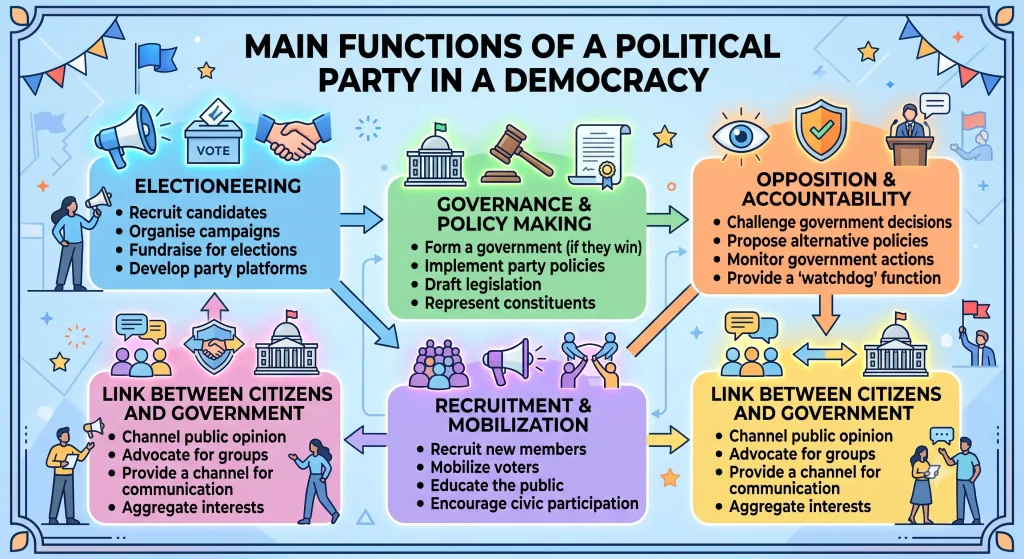
Here’s a quick summary of the main functions political parties perform:
- Candidate recruitment — identifying and nominating people to run for office
- Policy formation — building platforms that reflect voter priorities
- Voter mobilization — encouraging registration and turnout
- Government organization — structuring legislative and executive leadership
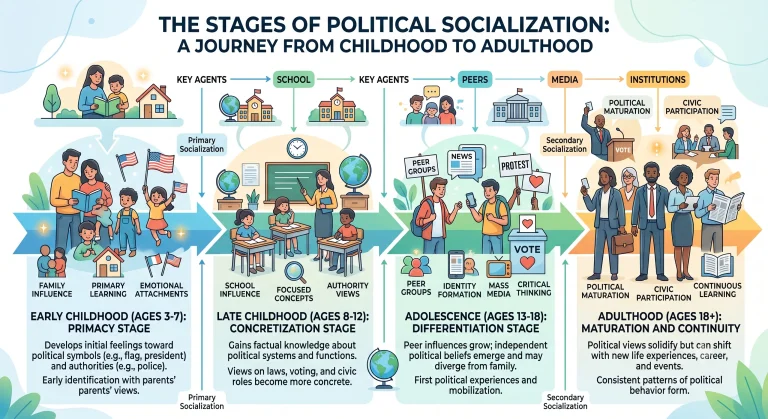
- Political socialization — educating citizens about issues and civic participation
- Opposition and oversight — checking the ruling party’s use of power
These functions are why political party is important in politics at every level, from local city councils to national parliaments.
Political Parties vs Independent Candidates
Independent candidates can and do win elections, but they face structural disadvantages that parties help solve.
| Factor | Party-Backed Candidate | Independent Candidate |
|---|---|---|
| Funding access | Party infrastructure and donor networks | Must self-fund or build a network from scratch |
| Voter recognition | Benefits from party brand and reputation | Must build name recognition alone |
| Legislative coalition | Built-in allies for passing laws | Must negotiate case-by-case |
| Long-term career path | Clear path through party ranks | No structured advancement path |
This is a key reason political party systems remain dominant even in countries that legally allow independent candidacies.
Challenges Facing Political Parties Today
Political parties aren’t without problems. Common criticisms include:
- Polarization — parties can deepen divisions instead of bridging them.
- Internal gatekeeping — party leadership sometimes limits genuine grassroots influence.
- Declining membership — many established democracies have seen falling party membership over recent decades.
- Money in politics — reliance on donors can shift party priorities away from average voters.
Understanding these challenges is part of understanding why party reform is a recurring topic in political science and public policy debates.
Real-World Examples
- The United States has operated a stable two-party system for well over a century, a pattern political scientists often link to its winner-take-all electoral rules.
- India has one of the largest multi-party systems in the world, with national and regional parties competing across its federal structure.
- The United Kingdom uses a parliamentary system where the majority party’s leader automatically becomes Prime Minister, directly linking party success to government formation.
These examples show that while party systems vary in structure, the underlying importance of parties in organizing political competition remains consistent worldwide.
Conclusion
Political parties are not just optional add-ons to democracy. They simplify voter decisions, organize government, represent collective interests, and hold leaders accountable. Whether in a two-party system or a multi-party parliament, the core reason political party is important in politics stays the same: parties turn individual political will into functioning, accountable government.
e) FAQ Section (Schema-Ready)
Q1: Why are political parties important in a democracy? Political parties organize elections, represent voter interests, and provide accountability by giving citizens a clear group to credit or blame for government performance.
Q2: What are the main functions of a political party? The main functions are candidate recruitment, policy formation, voter mobilization, organizing government, political education, and providing oversight of the ruling party.
Q3: Can a democracy function without political parties? Technically yes, but it becomes harder to organize legislatures, build voter coalitions, and ensure accountability without the structure parties provide.
Q4: What is the difference between a one-party and multi-party system? A one-party system has a single dominant or legally permitted party, while a multi-party system allows multiple parties to compete for and share power, often through coalitions.
Q5: How do political parties affect voter turnout? Party labels act as informational shortcuts, helping voters make faster decisions, which generally increases turnout compared to nonpartisan elections.